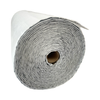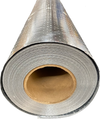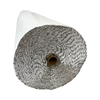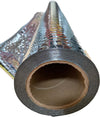
WE International logo - Globe with W E on its face and the words We meet your needs around the world around the globe. No-Tear Radiant Barrier logo. No-Tear is a radiant barrier designed to stop winter heat gain and summer heat loss.

Save up to 40% on your home's utility costs with No-Tear Radiant Barrier

What is No-Tear Radiant Barrier?

rFoil's No-Tear is a radiant barrier that is used primarily in residential construction to stop summer heat gain and winter heat loss. By installing this in your attic, you can reduce summer heat gain and winter heat loss by as much as 97%.


How does No-Tear Radiant Barrier work?

Radiant heat, the major source of heat flow, is energy in the form of infrared waves. It is transmitted from a heat source -- like the sun, a heater, or even your body -- at the speed of light, through the air. This means that in your house, up to 90% of summer heat gain, and up to 75% of winter heat loss, comes from RADIANT heat.

Unfortunately, typical bulk insulation (like foam and fiberglass), are designed to work against CONDUCTIVE heat (heat by physical contact) and CONVECTIVE heat (forced air). They're just not designed to work against the biggest culprit of heat gain and loss.

That's fine, but remember: up to 90% of summer heat gain and up to 75% of winter heat loss comes from RADIANT heat. Bulk insulation can't stop radiant heat -- 90% of that heat actually gets through it.

No-Tear works by reflecting radiant heat back toward the heat source -- it's like covering hot food with aluminum foil to keep it warm.

In fact, No-Tear is made from aluminum, so it's 97% reflective (which also means it's 3% emissive -- how much heat is given off, or emitted, through the insulation). That is, 97% of all radiant heat that hits it is reflected back toward its source.


What is the R-Value of No-Tear Radiant Barrier?

Because No-Tear is a radiant barrier, rather than a reflective insulation, it doesn't have an R-Value.

But R-Value is a misleading number. R-Value only measures CONDUCTIVE heat (heat by physical contact). And since 90% of all summer heat gain and 75% of all winter heat loss comes from RADIANT heat, R-Value is not actually a valid measurement of No-Tear's performance.

Compare reflective insulation to fiberglass

Notice how the temperature underneath the reflective insulation is 29º F cooler than the temperature under 6" of fiberglass.

The fiberglass has the much higher R-Value, but it's not doing more -- in fact, it's costing you money in increased utility costs.

This does not mean that you should use only No-Tear in your home. We strongly recommend that you use bulk insulation in your attic and walls -- it helps with air infiltration and helps prevent condensation, which are two other causes of high utility bills. (That, and building inspectors tend to get a little cranky when it's not in there!)


What does that mean?

It means that in the typical attic, there is anywhere from 1" to 12" of some kind of bulk insulation (foam, fiberglass, cellulose, rock wool, etc.). However, when the attic fills up with summer heat, that bulk insulation is only stopping a small fraction of the radiant heat -- 10 - 20%.

The rest of that heat is going into your house, which means the air conditioner runs continually to keep up with the constant heat flow. That means:

  1. Your air conditioner runs all the time;
  2. You're paying the increased electricity costs;
  3. Your house probably isn't comfortable enough, unless you really turn up the AC.

But by laying No-Tear on the attic floor, or stapling it across the roof rafters, you can stop that incoming heat, which means you'll reduce the amount of time your AC runs. Which means you'll save money on your utility bills. Some customers have saved as much as 40% on their monthly heating and cooling bills.


What about winter heat loss?

Do you remember that No-Tear is only 3% emissive? That it only gives off 3% of heat, because the rest is being reflected? Here's a secret about aluminum: it's always 3% emissive, even if nothing is being reflected on the other side.

This means that in the winter, if you have No-Tear on your attic floor, any heat that leaves your house is "caught" by No-Tear, because it can only emit 3% of it, regardless of whether it's being reflected or not.


Who else uses radiant barrier?

Believe it or not, radiant barriers are used a lot more than most people realize. For example:

If you have pizza delivered to your home, the delivery bag the pizza drivers carry uses a radiant barrier inside to keep the heat from escaping. That way your pizza stays warmer.

A thermos is a type of radiant barrier. There is an air space between the two reflective walls of a thermos, which helps reflect heat into, or out of, the thermos. That way the liquid inside can stay cooler or warmer.

Even NASA uses radiant barriers. They use ceramic heat tiles underneath the space shuttle. The walls of the space shuttle uses radiant barrier. Even the spacesuits have radiant barrier technology inside. Without radiant barrier, the walls of the shuttle would be 50' thick, and space walks would be impossible. In other words, if it's good enough for NASA, it's great for your home.


I want to use No-Tear Radiant Barrier. . .


How much No-Tear radiant barrier do I need?

Multiply the length of your attic by the width. That's the number of square feet you will need.

Would you rather put No-Tear on your roofline? Divide the total square feet by .85 (that's point-85). That's our method to determine the slope in the roof.

Divide that number by 500 (the number of square feet in a roll), and then round up to the next full integer (i.e. 2.5 becomes 3). That's the number of rolls you need. Multiply that by $115 (the price per roll, including shipping) for the total cost.

To place a credit card order, you can call us at (574) 457-3066. Or just email us at sales@radiantbarrier.net.


Is this the same thing as rFoil reflective insulation?

No. Although it's from the rFoil line, and we sell rFoil reflective insulation, the two products are not quite the same.

Regular reflective insulation is a vapor barrier, No-Tear isn't. This is important because you don't want to trap moisture in your attic.

No-Tear works strictly in a radiant heat setting, like your attic. Reflective insulation can be installed walls, ceilings, etc.

However, both No-Tear and rFoil reflective insulation are:

  • non-toxic
  • not affected by humidity or condensation
  • Class A/Class 1 fire rated (that's the best possible fire rating)
  • easy to install -- no protective garments are necessary
  • virtually indestructible -- No-Tear will not collapse, compress, or disintegrate over time (15 year warranty)
  • competitively priced
  • less expensive to ship than regular insulation.

Plus, birds, rodents, and insects don't eat it, or steal it for their nests.


Who is WE International?

WE International has been in business since 1994, selling building products and poultry equipment. We were the first to offer No-Tear Radiant Barrier to home owners, after having seen how well it worked in poultry houses around the world. We have attended numerous trade shows and home shows, and given countless presentations. (Erik Deckers, our former Director of Marketing was even on PBS' The American Woodshop to talk about No-Tear.)

You can find out more about WE International here.

You can also read testimonials from some of our satisfied customers here.


Location: No-Tear Radiant Barrier Home